
Bikefit Blog · 2 september 2025
Jarno Widar: where talent, biomechanics and innovation meet
We had the honour of guiding Jarno in our practice, and what struck us was not only his physique or his engine, but above all his willingness to invest in details that to outsiders often r
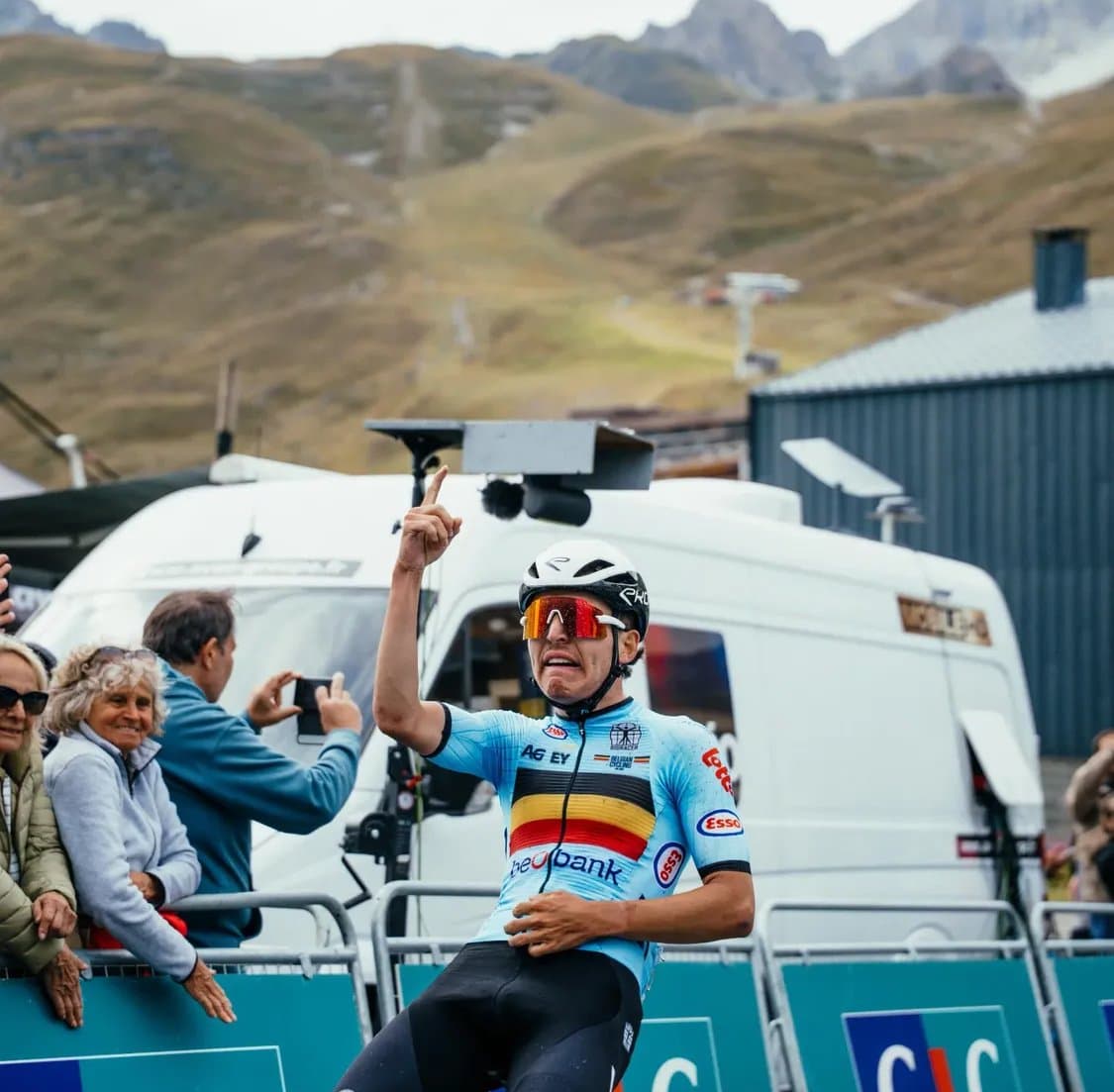
The 2025 cycling year is already down in the books as exceptional, but what Jarno Widar is showing this season is downright impressive. With a second place in the Tour de l'Avenir and two stage victories, he is settling into the ranks of riders who not only promise a bright future, but are already setting the tone now.
We had the honour of guiding Jarno in our practice, and what struck us was not only his physique or his engine, but above all his willingness to invest in details that to outsiders often remain invisible: the fine-grained biomechanics of posture, symmetry and efficiency.
The interplay of muscles, nerves and mechanics
In the bike fit world, saddle height, stem length or pedal width are often discussed, but beneath the surface deeper layers are at play:
• Neuromuscular control – How the brain drives the left and right sides symmetrically, how convergence and oculomotor function influence pelvic position via reflex arcs, and how the proprioceptive feedback of the feet and hands stabilises the upper body.
Neuromuscular control – How the brain drives the left and right sides symmetrically, how convergence and oculomotor function influence pelvic position via reflex arcs, and how the proprioceptive feedback of the feet and hands stabilises the upper body.
• Axial stability – With Jarno, particular attention was paid to the transition lumbosacral → pelvis → femur. A subtle pelvic rotation can cascade into knee loading, while a lack of gluteal activation is immediately noticeable in pedal pressure and pedalling efficiency. We measured this with EMG (muscle activity), thermal imaging and our own developed motion sensors.
Axial stability – With Jarno, particular attention was paid to the transition lumbosacral → pelvis → femur. A subtle pelvic rotation can cascade into knee loading, while a lack of gluteal activation is immediately noticeable in pedal pressure and pedalling efficiency. We measured this with EMG (muscle activity), thermal imaging and our own developed motion sensors.
What we saw: a rider who, through corrections, increased his symmetry and efficiency exponentially. And that translates directly into endurance and power, especially in the finale of hard rides.
Indoor precision, outdoor reality
Traditional bike fitting often remains limited to indoor analyses: pressure measurements, infrared scans, wired angle measurements. Useful, but not always representative of what happens in a race. A body is far more complex than that. A rider like Jarno is, after all, challenged by:
• fatigue and motor drift,
fatigue and motor drift,
• changing cadence and force distribution,
changing cadence and force distribution,
• external factors such as wind, gradient and road surface.
external factors such as wind, gradient and road surface.
That is why we are working on a step forward that is unique in the sport: high-tech sensors with which we will in the future be able to measure outdoors, live, during the performance or during training itself.
This technology – still discreetly in development – makes it possible to:
• detect asymmetries in foot rotation and pelvic stability, trunk stability, head movements during race situations,
detect asymmetries in foot rotation and pelvic stability, trunk stability, head movements during race situations,
• analyse micro-shifts,
analyse micro-shifts,
• provide real-time feedback on fatigue-related changes in posture.
provide real-time feedback on fatigue-related changes in posture.
Where classic bike fitting stops at the boundary of the test setup, we want to capture the real biomechanical truth: that of the road, the mountain, the wind, the race.
Jarno is one of the first athletes who will benefit from this. Not by using technology as a gimmick, but by using data as an extension of training, awareness and performance.
Why does this matter for top riders or for recreational cyclists?
Anyone who wants to reach the top of cycling today must do more than train. For people who ride the bike and experience complaints, more must be done than basic analyses. The difference between winning and losing is becoming ever narrower. The difference between cycling free of complaints and no longer being able to ride because of pain is too. A knee that deviates 2 degrees more inward, a pelvis that tilts a few millimetres, or a body that leans slightly too far to the right, can make the difference.
Jarno understands this like no other. His choice to refine these details shows the maturity of a rider who thinks ahead.
A promising future
Jarno Widar's performances this year are a fusion of talent, work and biomechanical refinement. We are convinced that the path he is taking, a combination of classic training work and cutting-edge biomechanical optimisation, will lead him to even greater heights in the long term.
For us, this is more than bike fitting: it is a laboratory of top-level sport and motor function, in which the boundary between physiology, neurology and technology blurs. And what Jarno shows is that shifting this boundary can also literally lead to victory in the toughest races for under-23 riders.
The story of Jarno Widar has only just begun.
#movebetter #pedalfurther #bikefitting
Bikefit Van Staeyen raises the new merged team Lotto Intermarché to an unprecedented bike fit level.
Spina.flow – The X-ray-free revolution in cycling posture and health
Ready to feel the difference?
Book your bikefit and leave with a position that fits your body and your goal.