Bikefit Blog · 6 februari 2025
From the snooker table to the triathlon bike: how Luca Brecel is pushing his limits
Luca Brecel is by nature an athlete with exceptional body control, but cycling over long distances calls for a different kind of load. His challenge does not lie in power, but in
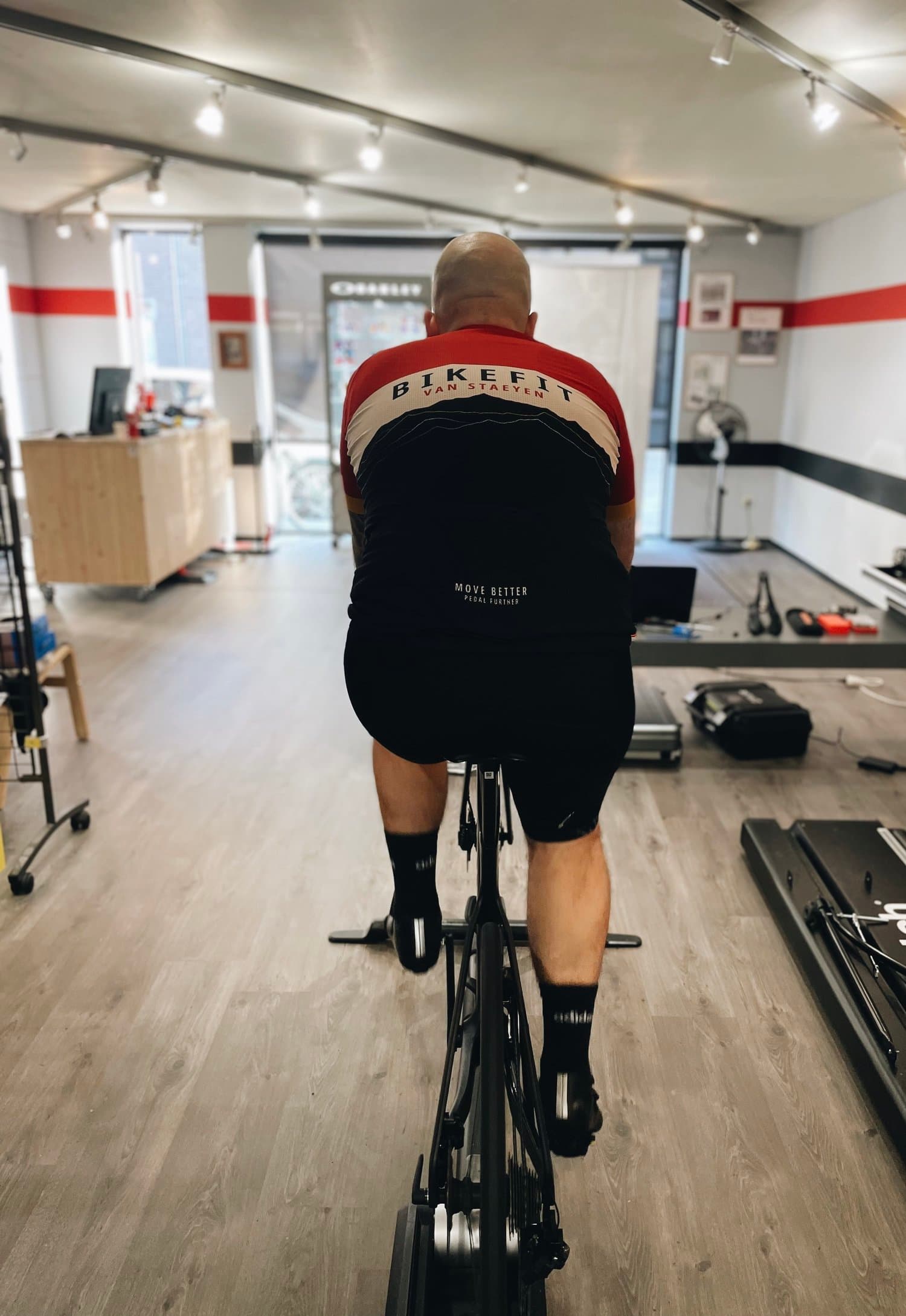
The transition from snooker to triathlon is a fascinating one, because whereas snooker revolves around static control, precision and minimal movement, triathlon is precisely a war of attrition in which endurance, efficiency and biomechanical balance make the difference between success and failure. Luca is setting his sights on new goals, with an Iron Man on the horizon. For us it was a great honour that a champion like Luca came knocking for his cycling position. Let us take you through his fascinating bikefit and share a few important takeaways.
Luca Brecel is by nature an athlete with exceptional body control, but cycling over long distances calls for a different kind of load. His challenge does not lie in power, but in finding an optimal position that combines maximum efficiency with long-term comfort.
The fundamental problems: what were we up against?
During the bikefit it quickly became clear that there were a number of structural limitations in his current cycling position. The main challenges:
🔴 Bike size and geometry Luca currently rides an XXS frame, which on paper seems suited to his height, but in reality imposes biomechanical limitations. The compact frame meant he was sitting too low, which led to excessive pressure on the wrists, forearms and shoulders.
🔴 Hand and arm pressure: Overload at the front The handlebar position that was too low and the relatively short reach caused too large a percentage of his body weight to be shifted forward. This not only led to discomfort, but also affected control of the bike in technical sections.
🔴 Effect on breathing and pedalling efficiency A position that is too compact with a pinched abdominal angle (hip angle) can have a negative impact on breathing. This is a problem especially for a triathlete, because oxygen uptake directly determines endurance performance.
The approach: how did we optimise Luca’s cycling position?
After an extensive analysis, we implemented a number of targeted adjustments that had immediately noticeable effects:
✅ Raising the handlebars By raising the stem and potentially considering a longer stem, we created a more open position, which immediately resulted in less pressure on the hands and a better weight distribution across the bike.
✅ Optimisation of the saddle position We analysed the pelvic rotation and pedalling angle and determined the most efficient position in which Luca’s quadriceps, gluteal muscle mass, hip rotators and hamstrings work together optimally, without additional load on the lower back.
✅ Visualisation of pedalling efficiency With our Peda.flow technology we mapped his pedalling motion three-dimensionally. This gave us valuable insights into the degree of power loss and asymmetry in his pedal stroke.
✅ Analysis of thermal load With our thermographic scan we could pinpoint exactly where excessive pressure and friction were arising. This helped to further refine the contact points on the saddle, the cleats and the handlebars, and mapped out several hotspots in the body.
What can other cyclists learn from this?
Luca’s case is a perfect example of how an incorrect cycling position not only causes discomfort, but also limits performance. Whether you are a competitive triathlete, gravel rider or recreational cyclist, there are a few fundamental lessons that apply to everyone:
📌 Your bike size on paper does not tell the whole story. An XXS or S frame may look correct, but the geometry can still impose biomechanical limitations.
📌 Look beyond wattage alone. Pedalling efficiency is not merely a matter of power, but above all of how your body converts that power into a smooth and sustainable movement.
📌 Prevent excessive pressure on hands and arms. A poor weight distribution can not only lead to discomfort, but also negatively affect control of the bike.
📌 An open hip angle is crucial for triathletes and long-distance cyclists. This prevents compression of the abdominal region and improves breathing, which directly impacts your endurance.
Conclusion: the power of a well-thought-out bikefit
The story of Luca Brecel shows how a professional bikefit helps athletes break through biomechanical barriers. In his case it was not only about wattage, but above all about physical balance, pressure distribution and long-term comfort.
Through a combination of cutting-edge technology, medical analysis and biomechanical optimisation, we were able to maximise his physical potential and prevent possible injuries.
📣 Would you also like to know whether your cycling position is holding back your performance? Or would you, like Luca, like to perfectly align your body and bike? Then a deep dive into your cycling position may well be the key to your next big step.
Spina.flow – The X-ray-free revolution in cycling posture and health
The crank length madness: everything you need to know about shorter cranks
Ready to feel the difference?
Book your bikefit and leave with a position that fits your body and your goal.