
Bikefit Blog · 27 december 2025
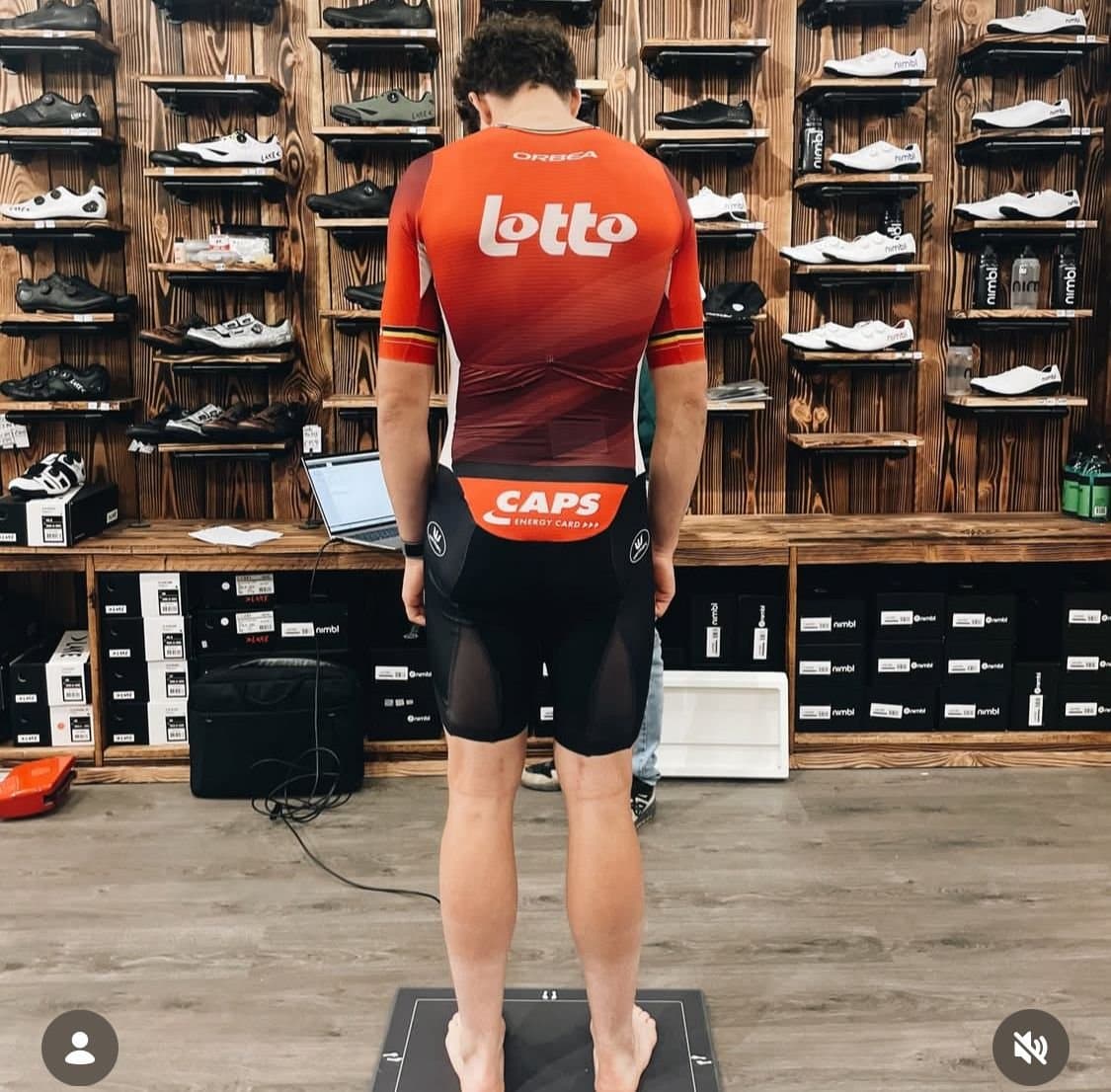
Bikefit Van Staeyen raises the new merged team Lotto Intermarché to an unprecedented bike fit level.
There is a persistent misconception in cycling: that the WorldTour is the endpoint of optimization. That once you get there, everything is right. That positions are "finished". That the body will simply ad
There is a persistent misconception in cycling: that the WorldTour is the endpoint of optimization. That once you get there, everything is right. That positions are "finished". That the body will simply adapt. Our experience says the opposite. This past winter we welcomed riders from various WorldTour teams into our facility and entered into a partnership with Lotto Intermarché, the new merger team that will operate at the highest level from 2026 onward. Not as a supplier. Not as a marketing partner. But as an independent biomechanical performance partner, for both road and TT bikes.
From bike position to human system
Bikefitting is often reduced to numbers:
• stack
stack
• reach
reach
• saddle height
saddle height
• angles
angles
But at WorldTour level, that is insufficient.
We do not start from the bike, but from the human system.
How does a rider truly move under load? Where do asymmetries arise under fatigue? Where is oxygen lost without anyone feeling it? Which compensations are "smart" and which are destructive in the long run? These are not theoretical questions. These are questions that decide races and, more broadly, resolve complaints.
Technology as a tool, not as truth
Within this collaboration we work with a set of tools that are still rarely used in full within the professional peloton:
• EMG (muscle activation & timing)
EMG (muscle activation & timing)
• NIRS / SmO₂ (local oxygen saturation)
NIRS / SmO₂ (local oxygen saturation)
• thermography (load & overcompensation)
thermography (load & overcompensation)
• dynamic movement analysis
dynamic movement analysis
• pressure and stability measurements
pressure and stability measurements
But let one thing be clear: data decides nothing. Data asks questions. People answer them. The difference lies not in the sensor, but in the understanding of biomechanics, neurology and load. In knowing why something changes when you shift 2 mm. And when it is better to change nothing. That is exactly why this collaboration works.
Groundbreaking progress in riders who already seemed "finished"
One of the most confronting insights in our work is this: the better a rider is, the more subtle the limiting factors become.
Jarno Widar
With Jarno we saw no classic "problems". Although we have been monitoring him for years, micro-asymmetries only became visible under specific load and intensity. Small differences in oxygen use, subtle timing differences in muscle activation, minimal pelvic rotations — nothing you see with the naked eye, but all-decisive at a high level.
By making his position not more aggressive, but more functional, we saw:
• calmer movement
calmer movement
• better symmetry under pressure
better symmetry under pressure
• more margin at high intensity
more margin at high intensity
No spectacular adjustment. But a fundamental one. Once again proof that an annual bikefit is a must for anyone who cycles.
Arnaud De Lie
With Arnaud it was not about "more aero" or "more comfort". It was about the durability of performance and a good feeling on the bike. How does a rider stay explosive without structurally exceeding his biomechanical limit? How do you prevent power from coming from the wrong chain? How do you safeguard the balance between power, stability and recovery?
By placing the body at the centre, and not the bike, we were able to optimize without compromising what makes Arnaud unique. His merciless sprint.
Jarno Widar with us in practice
Arnaud De Lie during a foot measurement for custom bike insoles.
One method, many profiles — why uniformity fails at the top level
One of the biggest misconceptions in high-performance bikefitting is the idea that a single "ideal" solution exists. That the same position, the same logic, the same approach would work for every rider competing at WorldTour level.
Our collaboration with Lotto Intermarché has confirmed exactly the opposite: the higher the level, the greater the individual differences.
Lennert Van Eetvelt — stability is not rigidity
Lennert is a rider who is exceptionally sensitive to changes. Not out of resistance, but because his performance is strongly linked to predictability and internal consistency. For him, optimization does not mean "adjusting more", but rather knowing what you do not change.
Biomechanical work with Lennert revolves around:
• minimal, targeted interventions
minimal, targeted interventions
• long observation periods
long observation periods
• respect for his internal motor control
respect for his internal motor control
That requires more patience, more listening, and above all: less ego from the fitter. But that is precisely where you win trust and performance.
Huub Artz — the future needs room, not force
With young riders like Huub Artz, the challenge lies not in correcting, but in not locking things down too early. Their body is still in full development, both neuromuscularly and biomechanically.
Our focus there is on:
• freedom of movement
freedom of movement
• symmetry under fatigue
symmetry under fatigue
• avoiding premature overcorrection
avoiding premature overcorrection
Not everything that "deviates" is a problem. Sometimes it is simply potential.
Taco Van Der Hoorn, Zimmerman and Beullens — you read experience in the body
In an experienced rider like Taco, Georg and Cédric you see something different: a body that has already processed thousands of race days.
There, bikefitting is not about optimizing, but about managing:
• which compensations have become functional?
which compensations have become functional?
• which load has grown historically?
which load has grown historically?
• where do you need to support rather than correct?
where do you need to support rather than correct?
With this type of rider you no longer change fundamentals. You make sure that what works keeps working, tomorrow as well.
Young talents, different trajectories
Riders like Steffen De Schuyteneer, Lars Craps, Jenno Berckmoes and the other talented riders show something that is often forgotten: talent does not develop linearly.
With them we look not only at:
• power
power
• aerodynamics
aerodynamics
• or numbers
or numbers
But above all at:
• stability of the chain
stability of the chain
• control under intensity
control under intensity
• recovery after load
recovery after load
What you allow today determines who they can become tomorrow.
One common thread: the person before the position
What all these profiles have in common, from established names to young prospects — is this: they do not ask for a "perfect" position. They ask for a position that works for them.
That is why this collaboration does not pursue standardization, but understanding. Why we measure, but never follow blindly. Why we change, but only when the body allows it. And that is precisely why this story fits Lotto Intermarché. Not because everyone is equal. But because everyone is taken seriously.
Spain, Flanders and far beyond
Over the past period we worked with the team several times in Spain, alongside our regular operation in Flanders. Not in a lab detached from reality, but in real context: training, intensity, fatigue.
What struck us again and again: a staff that is open to nuance. Riders who dare to feel instead of force. A team that understands that health and performance are not opposites. And perhaps even more importantly: that we remain fully independent in our work.
WorldTour… and then?
This collaboration does not mean that we "offer WorldTour level". It means that we redefine WorldTour. That we do not stop at: "this is how they do it in the peloton"
But go further towards: "this is how the body really works"
And that approach — the very same one we apply at Lotto Intermarché — also remains available for:
• competitive amateurs
competitive amateurs
• recreational riders with goals or recreational riders who enjoy their weekly bike ride
recreational riders with goals or recreational riders who enjoy their weekly bike ride
• riders with a complex history
riders with a complex history
• people who have already had several bikefits and feel that "something" is not right
people who have already had several bikefits and feel that "something" is not right
This is only the beginning
What we are building together with Lotto Intermarché goes beyond one season. Beyond one team. Beyond classic bikefitting.
This is about human performance at its limit, and how you do not force that limit, but push it further.
#movebetter #pedalfurther #bikefitting
Knee pain on the bike: why the knee is rarely the problem
Jarno Widar: where talent, biomechanics and innovation meet
Ready to feel the difference?
Book your bikefit and leave with a position that fits your body and your goal.