
Bikefit Blog · 13 mei 2026
Why a triathlon bikefit goes far beyond “sitting well on the bike”
Within the triathlon world, everything revolves around efficiency. Not only aerodynamic, but above all biomechanical and physiological. A fast position that your body cannot support will sooner or l
Within the triathlon world, everything revolves around efficiency. Not only aerodynamic, but above all biomechanical and physiological. A fast position that your body cannot support will sooner or later become a limiting factor. Power loss, asymmetries, overload and even a lack of oxygen in certain muscle groups can, in the long term, make the difference between performing… or surviving.
At Bikefit Van Staeyen, we therefore look not only at the position on the bike, but at the full interaction between body, bike and performance. Every triathlete moves differently. Every body compensates differently. And that is precisely where real performance fitting begins.
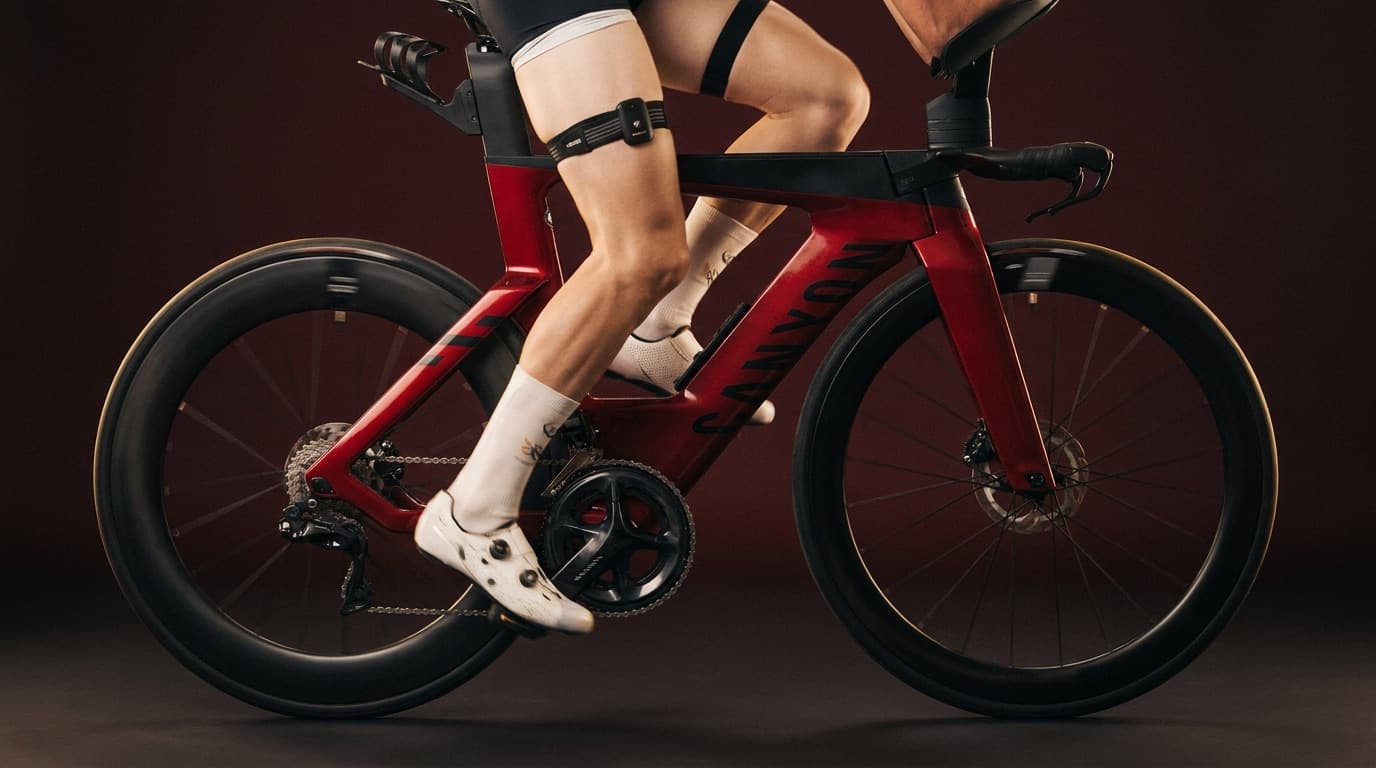
Over the past few weeks, we worked with several triathletes and performance athletes for whom biomechanics, stability and data analysis were central. Three cases perfectly demonstrate why a modern bike fit today goes far beyond a “comfort adjustment”. For the first time, we give an inside look at the bike fit of a professional triathlete, a triathlete with great ambition, and a recreational triathlete who will do a full Ironman.
Nick Thijs - professional triathlete
Combining aerodynamics with physiology
With Nick we worked on a TT setup, combining various technologies to create not only an aerodynamic, but above all a sustainable racing position heading towards Klagenfurt.
One of the most important tools during this session was NIRS (Near Infrared Spectroscopy). With it we measure real-time muscle oxygenation and oxygen saturation during exertion. This allows us to objectively analyse how efficiently muscles function within a given position.
Small changes in:
• arm angle
arm angle
• hip angle
hip angle
• reach
reach
• crank length
crank length
• shoulder stability
shoulder stability
immediately produced measurable differences in:
• muscle load
muscle load
• oxygen use
oxygen use
• stability
stability
• power build-up
power build-up
And that is exactly what modern triathlon bike fitting is about today: not simply “lower and aero”, but creating a position that the body can genuinely sustain over long distances.
An aggressive position that is not biomechanically stable often costs more energy than it gains aerodynamically.
By combining biomechanics and physiological data, we were able to position Nick in a much more stable, efficient and sustainable TT posture, without sacrificing speed. Nick is more than ready for his next goal: the Ironman in Klagenfurt.
Lenie Boons
The body never lies..
With Lenie we saw clear asymmetries off the bike that directly influenced the position while cycling.
The pelvis stood clearly lower on the left, with a compensatory curvature in the spine. In addition, the right foot dropped more inward, causing the right leg to fall more into a valgus position (“knock-kneed”).
The result? Compensations throughout the entire chain:
• rotation of head and upper back
rotation of head and upper back
• asymmetrical loading
asymmetrical loading
• pressure differences on saddle and pads
pressure differences on saddle and pads
• loss of stability
loss of stability
On the bike we saw more pressure on the saddle on the left, while more support was sought on the aeropads on the right. The body always tries to find a way to keep itself stable.
Through a number of external compensations, combined with a correct saddle height and setback, the entire movement pattern changed.
Suddenly we saw:
• more symmetry
more symmetry
• less pelvic movement
less pelvic movement
• more stable trunk control
more stable trunk control
• calmer pedalling behaviour
calmer pedalling behaviour
And that perfectly demonstrates why a bike fit is never only about the bike. The body always determines the position, not the other way around.
Michaël Van De Maele
Stability begins at the foot
With Michael we saw a completely different problem. Here the greatest limiting factor lay on the right side of the kinetic chain.
The right foot constantly sought stability during the pedalling cycle. In addition, the foot was clearly more in supination (outward), causing force transfers to run unstably and compensations to arise higher up.
What many athletes underestimate: the foot is literally the foundation of the entire riding position.
When instability arises there, the body starts to compensate:
• pelvic rotation
pelvic rotation
• asymmetrical pressure distribution
asymmetrical pressure distribution
• shoulder loading
shoulder loading
• reduced efficiency
reduced efficiency
• increased muscle activity
increased muscle activity
Through targeted support with a custom-made functional insole, we were able to make the lower chain much more stable.
In addition, the saddle was initially too high and the drop to the handlebars too aggressive. By correcting these parameters, the following arose:
• more calm in the pelvis
more calm in the pelvis
• better control of the trunk
better control of the trunk
• less overload
less overload
• more stable power transfer
more stable power transfer
Important here: a lower front position is not automatically faster.
When stability disappears, you often lose more watts than you gain aerodynamically.
Data are important. But interpretation is everything.
Today there are more and more tools:
• motion capture
motion capture
• pressure measurements
pressure measurements
• NIRS
NIRS
• saddle mapping
saddle mapping
• EMG
EMG
• video analysis
video analysis
• AI systems
AI systems
But technology alone does not make a good bike fit.
The real added value lies in:
• understanding compensations
understanding compensations
• listening to the athlete
listening to the athlete
• interpreting the data
interpreting the data
• combining biomechanics with performance
combining biomechanics with performance
Every triathlete has:
• a different mobility
a different mobility
• different asymmetries
different asymmetries
• a different load capacity
a different load capacity
• different physiology
different physiology
#movebetter #pedalfurther #bikefitting
Knee pain on the bike: why the knee is rarely the problem
Ready to feel the difference?
Book your bikefit and leave with a position that fits your body and your goal.