
Bikefit Blog · 9 april 2024
The Puzzle Piece of the Spring: complex saddle and foot problems combined with a numb hand
The history of the science of movement cannot be told without paying tribute to Sir Isaac Newton, whose three laws of motion and gravity form the basis of how we understand forces today
In a world where precision and performance converge at the intersection of human effort and technological innovation, the science of bike fitting takes centre stage. This story, a bike fit from March interwoven with scientific discoveries and biomechanical insights, takes us on a fascinating journey from the fundamental principles of Isaac Newton to the advanced practices of contemporary osteopathy and bike fitting. We take you through the bike fit of person X, David.
The departure: the problem of person X:
We turn our attention to an individual who would rather not be named. In this blog we will call him David. David experienced several challenges before he came to us for a bike fit: an asymmetry in dorsiflexion of the ankle joint, a discrepancy in hamstring flexibility, and a noticeable deviation in the loading of the pelvis and thoracic compensation (compensation of the chest region) came to light during the bike fit. These complex layers of imbalance manifested themselves in a series of symptoms while cycling, including discomfort on the saddle (primarily a saddle complaint on the left), a numb right hand, particularly the ring finger and the little finger, a painful left foot, and a clear preference for loading on one side. Before delving deeper into this, we would first like to explore the fundamentals of forces on the bike, in order to better understand what was going on here, and to take you through the various technologies we used during the bike fit.
The Fundamentals of Motion and Force
The history of the science of movement cannot be told without paying tribute to Sir Isaac Newton, whose three laws of motion and gravity form the basis of how we understand today the forces acting on the cyclist and the bike. These centuries-old principles are still relevant in the complex biomechanics of bike fitting, where the balance between force and motion is essential for optimal performance and comfort.
Newton's First Law: An Object at Rest Stays at Rest, and an Object in Motion Stays in Motion
When David sits on his bike and begins to pedal, Newton's first law, the law of inertia, comes into play. This law states that an object in motion will continue to move in a straight line at a constant speed unless it is acted upon by an external force. In the context of bike fitting, this helps us understand why it is essential to adjust David's saddle and handlebars correctly. An optimal saddle height and handlebar position ensure that David can transfer his power efficiently without unnecessary movements that could disrupt his trajectory. The right balance and posture reduce the external forces that could hinder his movement, such as air resistance or unnecessary muscle tension.
Newton's 1st law
Newton's Second Law: F=ma (Force equals mass times acceleration)
This law plays a crucial role in how David applies force to the pedals. The amount of force David exerts on the pedal, combined with his mass and the acceleration of his bike, determines how fast he can go. In bike fitting, we look at the most efficient way to apply this force. By optimising the crank length and the position of the cleat, for example, we were able to ensure that David's power is converted as directly as possible into forward motion, thereby increasing his acceleration and speed without extra effort.
Correct adjustment of the cleat with a laser device
Newton's Third Law: for every action there is an equal and opposite reaction
When David pedals, he exerts force downwards on the pedals; the pedals and the bike return an equal and opposite force, which propels him forward. This principle is fundamental in determining the ideal riding posture. Correct balance and weight distribution ensure that the reaction force of the bike helps David to move forward more efficiently. It also helps to minimise energy loss through slipping or inefficient movement. In practice, we use these principles of physics to carry out a bike fitting that optimises David's performance. By taking into account his physique, flexibility, and strength, we were able to create a riding posture that respects the natural laws of motion and enables him to fully realise his potential, while at the same time increasing his comfort and reducing the risk of injury.
Our nourishment: the technology
By using EMG analysis, IMU sensors on the pelvis, thorax, feet and legs, and CoG measurements in collaboration with the University of Antwerp, we have the ability to delve deeply into the biomechanical state of the individual. The EMG data, for example, revealed reduced activation in the right gluteus medius at low wattages, while the CoG and foot pressure measurements showed a predominant loading on the left side of the bike. The gluteus medius acts here as a pelvic stabiliser and is fundamental to pelvic stability on the bike.
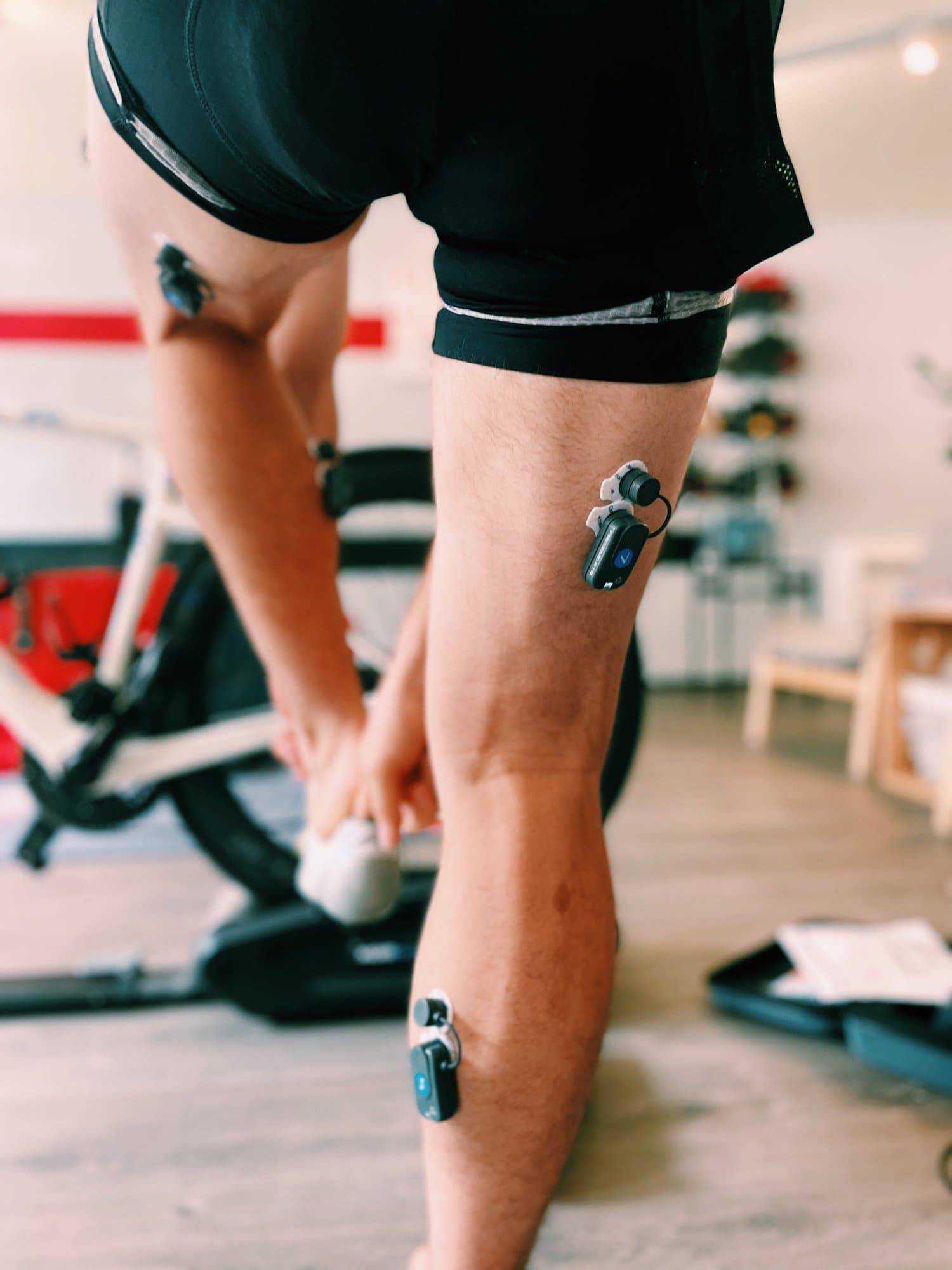
Electromyography (EMG) maps the electrical activity of muscles, an indispensable tool in our quest for biomechanical perfection. By analysing the activity of specific muscle groups, such as, in David's case, the gluteus medius, hamstrings, tibialis anterior (foot lifter) and quadriceps, we gained in-depth insight into the efficiency of David's muscle function and identified asymmetries that affect pedalling dynamics.
Inertial measurement units (IMUs), strategically placed on, among other things, the PSIS (posterior superior iliac spine) and other crucial points, provide real-time data on the orientation, acceleration and rotation of the body in space. This technology offers an unprecedented view of how the pelvis moves during the cycling motion, which is essential for tailoring the riding position to David's unique biomechanics.
EMG sensors for muscle activation
Tiny motion sensors
The Science of Pressure: Foot and Saddle Pressure Measurement
The baropodometric foot pressure measurement, expressed in g/cm2, and the saddle pressure measurement revealed the interaction between David and his road bike at the most intimate points of contact. This data, collected under dynamic conditions, helped to optimise the saddle height, angle and position, as well as the adjustment of the cleats, in order to reduce pressure points and maximise efficiency. In this way, we saw that his left foot was under extreme pressure, both during the push and the pull phase. In this way the foot was never relieved and continuously loaded by his carbon shoe while cycling. What was striking was that the pressure manifested itself mainly on the outside of the foot and at the level of the big toe.
By mapping David's centre of gravity (CoG), a concept that comes directly from Newton's treatises, we were able to map and improve David's stability. These measurements helped us to create a position in which force is transferred efficiently. A balance that is essential for both time triallists and road racers. As expected, during the analysis we saw that his centre of gravity lay mainly to the left of the bike. Our unique measurement system provided clear data with which we could work to stabilise further. Moreover, this stability has a very significant impact on the vestibular system, the balance organ, and the inner ear. But what role does the inner ear play in balance on the bike?
The Inner Ear: A crucial player in Balance and Orientation
A particular aspect of our analysis is the role of the vestibular system within the inner ear. This sophisticated organ is vital for maintaining balance and orientation. Disturbances in this system can have subtle but significant effects on balance, which is crucial for activities such as cycling. In David's case, we were dealing with a slanted position on the saddle with more forces to the left of his bike. This caused inefficiency and compensation at the level of the thorax and also the head. David's head was, both off and especially on the bike, permanently rotated to the left. Ultimately, through a number of tests and adjustments to the riding position and cleats, we found stability and reduced compensation of the head.
In all of this, osteopathy played a crucial role, by looking not only at the freedom of movement and muscle strength, but also at the deeper connections between the musculoskeletal system, the organs, and even the influence of the inner ear on balance and perception. Correcting dysfunctions within this complex system can lead to improvements in posture and performance on the bike. In this blog post we will not go into David's specific medical background.
The arrival: the art of the possible
Ultimately, we were able to map out David's problems clearly and help him get rid of his complaints. David currently rides free of complaints thanks to the contemporary technology and experience we have in house. David's bike fit illustrates the crucial importance of an integrated approach that combines technological precision with a thorough understanding of human anatomy and physiology. By combining the powers of advanced diagnostic tools and osteopathic principles, we can not only optimise the cycling experience in terms of performance and comfort, but also contribute to the long-term well-being of the cyclist.
From talent to triumph: Maxim Van Gils and the rising stars of Lotto Dstny and Team Flanders Baloise
How top talent Duarte Marivoet and professional rider Dries Van Gestel benefit from advanced bike fit technologies
Ready to feel the difference?
Book your bikefit and leave with a position that fits your body and your goal.